Most Projects Are Not Google Scale and Infrastructure Should Reflect That
The hyperscaler default — AWS, GCP, Azure — made sense when they had no competition and cloud was new. In 2026, running a production SaaS on AWS without a deliberate cost strategy means paying 3–5× more than necessary for compute that a European VPS provider delivers for a fraction of the price. Hetzner is that provider, and it’s not a compromise.
The Price Reality
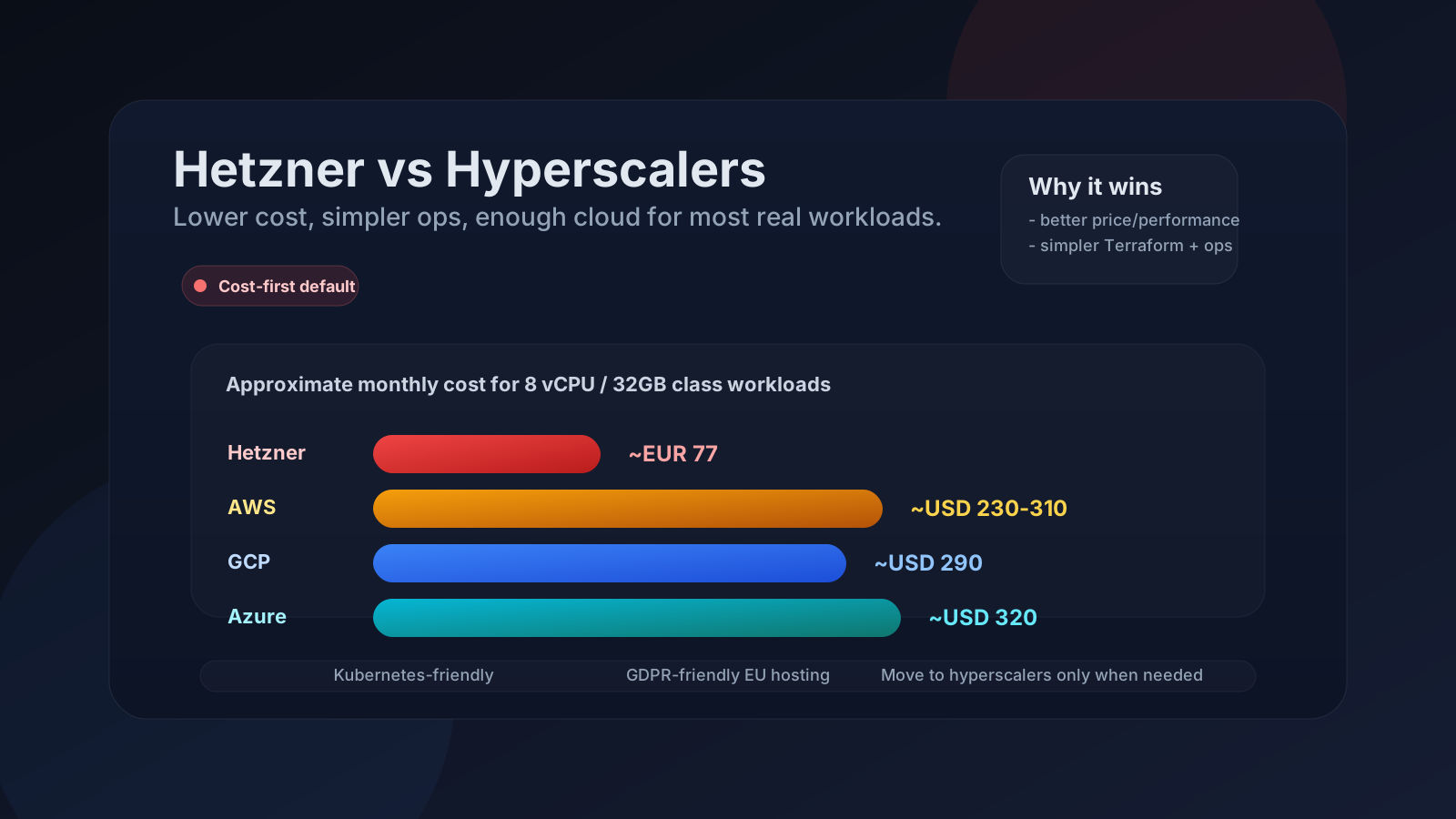
Concrete numbers. A workload requiring 8 vCPUs and 32GB RAM:
| Provider | Instance Type | Monthly Cost (approx.) |
|---|---|---|
| Hetzner Cloud | CCX33 (8 vCPU, 32GB) | ~€77 |
| AWS | c7g.2xlarge (8 vCPU, 16GB) | ~$230 |
| AWS | m7g.2xlarge (8 vCPU, 32GB) | ~$310 |
| GCP | n2-standard-8 (8 vCPU, 32GB) | ~$290 |
| Azure | D8s v5 (8 vCPU, 32GB) | ~$320 |
Hetzner is not cheaper by 20%. It’s cheaper by 70–80%. For a stack running 5–10 servers, that’s the difference between a €500/month infrastructure bill and a €3,000/month one.
Add managed databases, load balancers, object storage, and network egress to AWS, and the gap widens further — AWS charges for egress at $0.09/GB. Hetzner includes 20TB of traffic per server per month in the base price. For data-intensive applications, this alone justifies the switch.
What Hetzner Actually Offers
Hetzner Cloud is not a bare-metal provider with a web UI bolted on. It’s a full cloud platform:
- Compute: Shared and dedicated vCPU instances (AMD and Intel), ARM64 instances
- Block storage: Up to 10TB volumes, attachable to any server
- Object storage: S3-compatible (Hetzner Object Storage) via API
- Managed databases: PostgreSQL and MySQL, point-in-time recovery
- Load balancers: Layer 4 and Layer 7, automatic TLS
- Private networking: VLAN-based private networks, firewall rules
- Kubernetes: Hetzner Cloud Controller Manager for self-managed K8s, or use Hetzner’s managed offering
- Datacenters: Nuremberg, Falkenstein, Helsinki (EU); Ashburn, Hillsboro ( US)
The API is clean, the Terraform provider is first-class, and the developer experience is straightforwardly better than navigating AWS console.
Infrastructure as Code on Hetzner
The Hetzner Terraform provider is mature and covers the full platform:
terraform {  required_providers {    hcloud = {      source  = "hetznercloud/hcloud"      version = "~> 1.47"    }  }}
provider "hcloud" {  token = var.hcloud_token}
resource "hcloud_network" "main" {  name     = "production-network"  ip_range = "10.0.0.0/16"}
resource "hcloud_network_subnet" "app" {  network_id   = hcloud_network.main.id  type         = "cloud"  network_zone = "eu-central"  ip_range     = "10.0.1.0/24"}
resource "hcloud_server" "app" {  count       = 3  name        = "app-${count.index + 1}"  server_type = "cx32"  # 4 vCPU, 8GB, €19.79/mo  image       = "ubuntu-24.04"  location    = "nbg1"
  network {    network_id = hcloud_network.main.id    ip         = "10.0.1.${count.index + 10}"  }
  user_data = file("cloud-init/app.yaml")}
resource "hcloud_load_balancer" "main" {  name               = "app-lb"  load_balancer_type = "lb11"  location           = "nbg1"}
resource "hcloud_load_balancer_target" "app" {  count            = 3  type             = "server"  load_balancer_id = hcloud_load_balancer.main.id  server_id        = hcloud_server.app.id  use_private_ip   = true}
resource "hcloud_managed_database" "postgres" {  name        = "app-postgres"  type        = "pg-2"  # 2 vCPU, 4GB, HA available  version     = "16"  location    = "nbg1"}
No vendor lock-in beyond the Hetzner API itself — and switching providers means changing a Terraform provider and resource types, not rewriting application code.
Kubernetes on Hetzner
Self-managed Kubernetes on Hetzner with k3s and the Hetzner Cloud Controller
Manager is a common production pattern:
# k3s control plane installcurl -sfL https://get.k3s.io | sh -s - server \  --disable=traefik \  --disable=servicelb \  --node-label="node-role=control-plane"
# Worker joincurl -sfL https://get.k3s.io | K3S_URL=https://<control-plane-ip>:6443 \  K3S_TOKEN=<node-token> sh -
# hcloud-secret.yaml — Hetzner Cloud Controller ManagerapiVersion: v1kind: Secretmetadata: name: hcloud namespace: kube-systemstringData: token: '<hetzner-api-token>' network: '<network-id>'With the CCM installed, Kubernetes LoadBalancer services automatically provision Hetzner Load Balancers. Persistent volumes use Hetzner block storage via the CSI driver. The operational surface is similar to EKS or GKE at a fraction of the cost.
Alternatively, Hetzner’s managed Kubernetes (K8s) removes the control plane management burden entirely.
GDPR and Data Residency
Hetzner is a German company, subject to GDPR. Data stored in their EU datacenters stays in the EU under German/Finnish jurisdiction — a hard requirement for many European enterprise customers, healthcare workloads, and financial services applications.
AWS and GCP offer EU regions, but their parent companies (Amazon, Google) are US entities subject to CLOUD Act jurisdiction — a compliance consideration that some data controllers cannot accept. Hetzner sidesteps this entirely.
For EU-based startups building B2B SaaS for European customers, this is not a minor point.
When Hyperscalers Are the Right Call
Hetzner is not always the answer. Be specific about when you actually need AWS/GCP/Azure:
| Use Case | Hyperscaler Justified? | Reason |
|---|---|---|
| Global multi-region (10+ regions) | Yes | Hetzner has 5 locations vs 30+ for AWS |
| AWS-native services (Bedrock, SageMaker, etc.) | Yes | No Hetzner equivalent |
| Enterprise compliance (FedRAMP, HIPAA BAA) | Yes | Hetzner not certified |
| Kubernetes at 1000+ node scale | Yes | Managed control plane at that scale matters |
| Serverless / event-driven workloads | Yes | Lambda, Cloud Run have no Hetzner equivalent |
| Startup with AWS credits ($100k+) | Situationally | Use the credits, then re-evaluate |
| Standard web/API/data workloads | No | Hetzner delivers the same outcome cheaper |
| Side projects, developer tools, SaaS MVPs | No | 70% cost reduction with zero capability loss |
The pattern is clear: hyperscalers are justified when you need their specific managed services or global footprint. For general compute, databases, object storage, and Kubernetes — Hetzner is cost-equivalent on capability and dramatically cheaper.
The Operational Reality
Hetzner’s uptime track record is solid. Their status page history shows availability comparable to major cloud providers for standard compute — not identical, and without the SLA-backed guarantees of AWS, but sufficient for most production workloads when running with redundancy.
Support is email-based, not 24/7 phone. For teams with internal infrastructure competence, this is fine. For teams that need a support contract with guaranteed response SLAs, that’s a real gap.
The network is Hetzner’s own — fast within their infrastructure, standard commodity uplinks externally. For globally distributed CDN-sensitive workloads, supplement with Cloudflare (free tier covers most cases) in front of Hetzner origin servers.
The Default Should Be Hetzner
The mental model I’ve landed on: start on Hetzner, migrate specific workloads to hyperscalers when a concrete requirement forces it. Not the reverse — don’t start on AWS because it’s the default, then discover you’re spending €5,000/month on infrastructure a €400/month Hetzner stack would handle identically.
Money spent on compute that doesn’t need to be on AWS is money not spent on engineers, product, or users. For a funded startup, that’s an engineering decision with direct business consequences. For a bootstrapped project, it’s the difference between sustainable and not.
The best infrastructure is the infrastructure you don’t have to think about because it’s reliable, affordable, and operationally simple. Hetzner delivers that for the majority of production workloads I run.