Complexity Is a Cost You Pay Upfront
Microservices distribute your system. They also distribute your complexity, your operational burden, your debugging surface, and your team’s cognitive load. For a startup of 3–15 engineers trying to find product-market fit, that’s a tax you cannot afford.
The modular monolith isn’t a consolation prize. It’s a deliberate architectural bet with a well-understood payoff profile.
The Microservices Mirage
The pitch is compelling: independent deployments, language freedom, team autonomy, infinite scale. In practice, startups adopting microservices early inherit the operational complexity of Netflix without Netflix’s platform engineering team to absorb it.
What they actually get:
- Distributed tracing overhead before any meaningful traffic exists
- Network latency and partial failure in what were simple function calls
- Schema coupling disguised as independence — services share data contracts that are harder to evolve than a shared database schema
- Deployment pipelines that are 10× more complex for 10× less throughput than the team can even generate
- Local development friction — running 12 services locally requires Docker Compose files that become a part-time maintenance job
The startup graveyard has companies that died operationally, not from lack of product vision.
What a Modular Monolith Actually Is
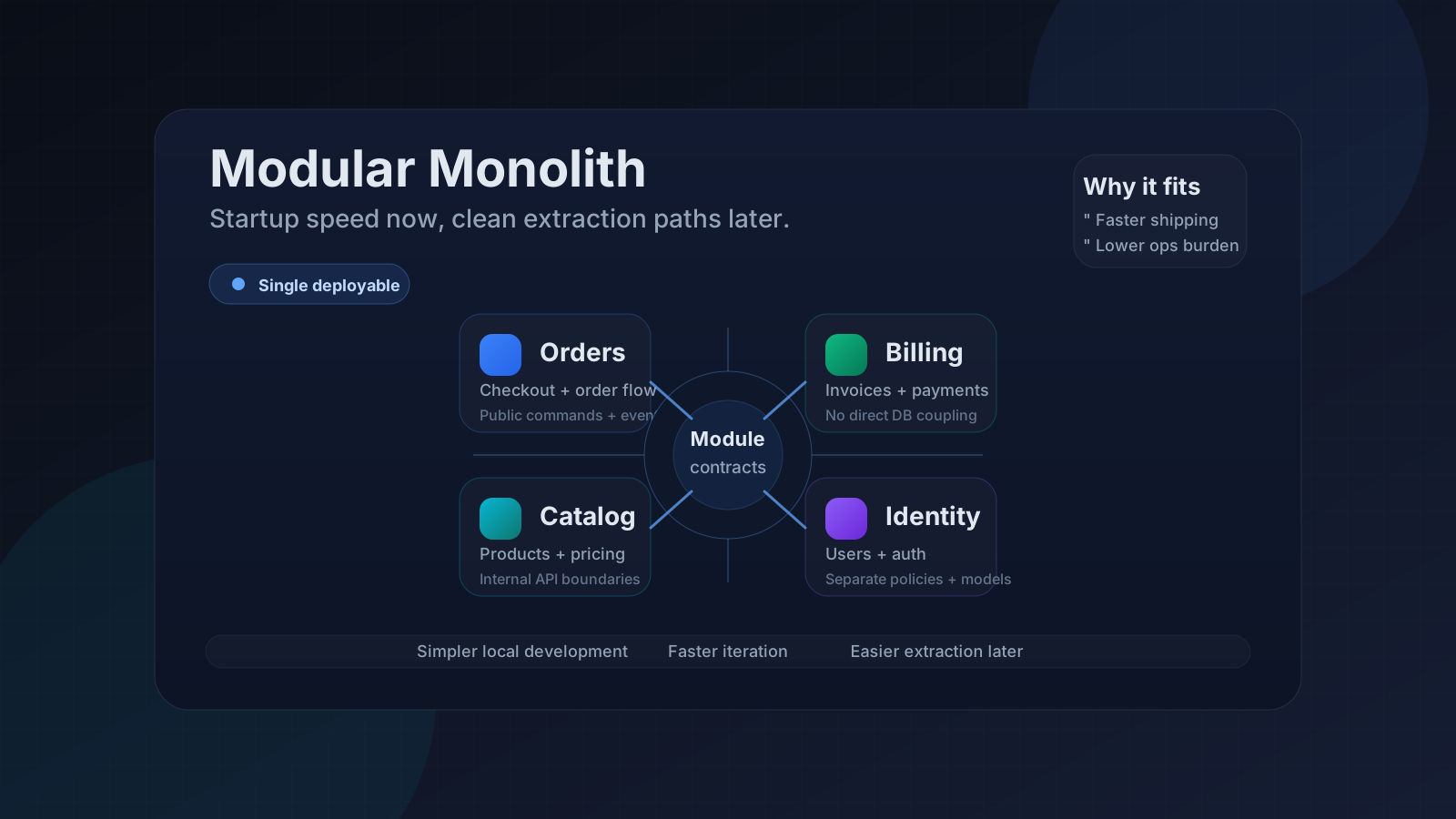
A modular monolith is a single deployable unit with hard internal module boundaries. Modules communicate through explicit interfaces — not through a shared database layer, not through direct class coupling.
Think of it as microservices co-located in one process, with the network calls replaced by in-process interfaces. The discipline is the same. The operational overhead is not.
src/├── modules/│ ├── billing/│ │ ├── api/ # Public interface — the only thing other modules see│ │ │ └── BillingService.java│ │ ├── internal/ # Private implementation│ │ │ ├── BillingServiceImpl.java│ │ │ ├── InvoiceCalculator.java│ │ │ └── PaymentGatewayClient.java│ │ └── BillingModule.java│ ├── identity/│ │ ├── api/│ │ │ └── IdentityService.java│ │ └── internal/│ │ └── ...│ └── catalog/│ ├── api/│ │ └── CatalogService.java│ └── internal/│ └── ...└── shared/ ├── domain/ # Shared value objects, not business logic └── infrastructure/ # DB, messaging, HTTP clientsThe internal/ packages are inaccessible to other modules — enforced by
package-private visibility, ArchUnit tests, or Java 9 module system (
module-info.java). The api/ package is the contract.
This is the entire discipline. Everything else — test isolation, deployment, scaling — follows from it.
Enforcing Boundaries with ArchUnit
Boundaries that aren’t enforced aren’t boundaries. They’re suggestions that erode under deadline pressure.
@AnalyzeClasses(packages = "com.myapp")public class ModularBoundaryTest {    @ArchTest    static final ArchRule billing_internals_not_accessed_outside_module =        noClasses()            .that().resideOutsideOfPackage("com.myapp.modules.billing..")            .should().accessClassesThat()            .resideInAPackage("com.myapp.modules.billing.internal..");
    @ArchTest    static final ArchRule modules_communicate_only_via_api_packages =        noClasses()            .that().resideInAPackage("com.myapp.modules.catalog..")            .should().accessClassesThat()            .resideInAPackage("com.myapp.modules.billing.internal..");}
This runs in CI. Any developer who reaches across a module boundary gets a failing test, not a code review comment three days later.
The Migration Path to Microservices
The real value of a modular monolith isn’t just fast initial shipping. It’s that well-enforced module boundaries make future extraction trivial.
When a module needs to scale independently — because its traffic profile, team ownership, or technology requirements diverge — you extract it. The interface is already defined. The data contract is already explicit. The dependency graph is already clean.
| Migration Step | Modular Monolith Starting Point | Big-Ball-of-Mud Monolith Starting Point |
|---|---|---|
| Identify service boundary | Module boundary is already the boundary | Requires months of domain analysis |
| Define API contract | Already exists as a Java interface | Must be reverse-engineered from call sites |
| Data ownership | Module owns its tables (by convention or schema) | Tables shared across dozens of call paths |
| Extract and deploy independently | Replace in-process call with HTTP/gRPC | Full rewrite required |
| Risk | Low | Very high |
The modular monolith doesn’t prevent microservices. It makes them optional — and when you do extract, you extract from a position of clarity rather than desperation.
Where Monoliths Break Down
Be honest about the limits:
- Deployment coupling — a bug in the billing module requires a full redeploy. If deployments are infrequent and team discipline is high, this is manageable. If you ship 20 times a day with 5 independent teams, it becomes a coordination problem.
- Vertical scaling ceiling — a single process scales up, not out. If one module is genuinely compute-bound at a scale the single host can’t serve, extraction becomes necessary, not optional.
- Technology heterogeneity — if one module genuinely needs Python’s ML ecosystem and another needs JVM throughput, a shared process isn’t viable.
- Team size inflection — around 30–50 engineers working on the same codebase, merge conflicts and CI queue times become real friction. This is the natural extraction signal.
None of these apply to a 5-person startup in month 6.
The Honest Comparison
| Dimension | Modular Monolith | Microservices |
|---|---|---|
| Initial complexity | Low | High |
| Operational overhead | Low (one process, one deploy) | High (service mesh, tracing, CI/CD per service) |
| Local dev experience | Simple | Complex (Compose, mocking, service discovery) |
| Cross-module refactoring | Fast (one repo, one compile) | Slow (contract negotiation, versioning) |
| Debugging | Straightforward (single trace) | Requires distributed tracing |
| Independent scaling | Not possible per-module | Yes, per service |
| Team autonomy at scale | Limited | High |
| Time to first production deploy | Days | Weeks to months |
| Extraction to microservices | Straightforward (clean boundaries) | N/A (already distributed) |
For a startup optimizing for shipping and learning: the left column wins until it doesn’t.
What “Modular” Requires Culturally
The architecture only holds if the team treats module boundaries as inviolable. That means:
- Code review rejects PRs that reach into
internal/packages across modules - Each module owns its own database schema or table prefix — no cross-module joins
- Inter-module communication is always via the public
api/interface — never via shared service beans called directly - New features start by asking: “which module owns this?” before writing a line of code
This is the same discipline microservices enforce via network boundaries. The modular monolith requires it via team culture and tooling (ArchUnit, package visibility). It’s lighter. It’s not free.
The Pragmatic Default
For most startups: start with a modular monolith, enforce boundaries from day one, and extract services when a specific module gives you a specific problem that extraction solves.
Not when someone reads a Martin Fowler post. Not when a new hire comes from a FAANG with microservices muscle memory. When the module’s traffic, team structure, or technology requirements make the single-process constraint genuinely painful.
Ship fast. Stay modular. Extract deliberately.